Archive for the ‘art’ Category

Back from the Framers

Wednesday, July 14th, 2010

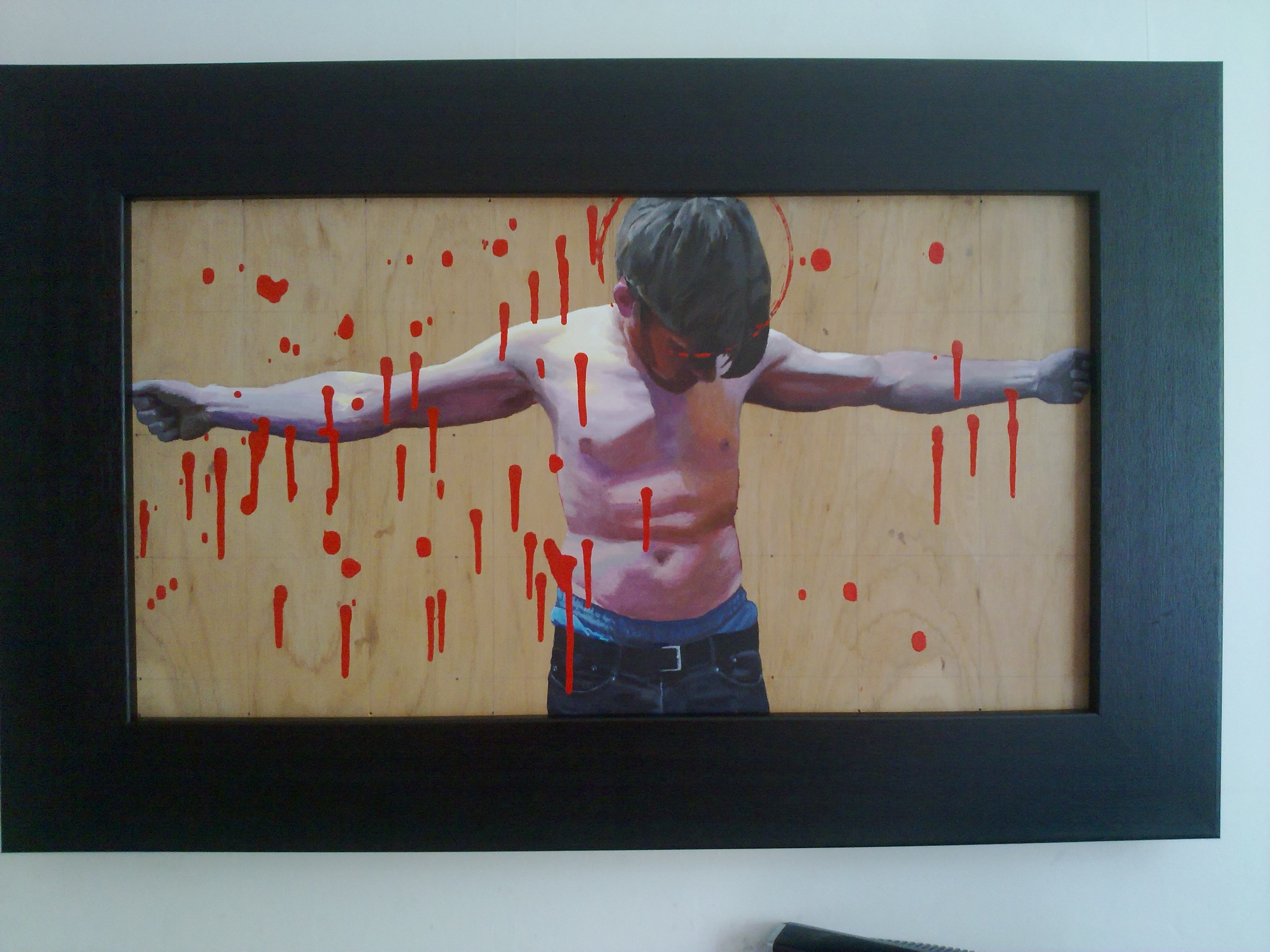
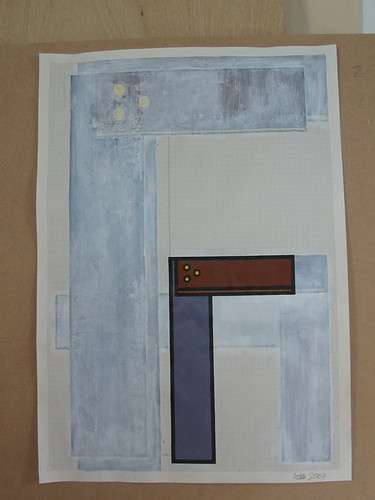
I’ve just got this piece back from the framers.

I’m immensely happy with the way this has turned out. The framing was done by GX gallery in Camberwell, South London. I found them quite by accident – I’d gone to King’s College Hospital for a Physiotherapy appointment, and arrived a little bit early. While wandering around to pass the time, I happened upon them. They were very helpful, and Richard gave me some good advice while I was trying to decide on a frame. Their building is amazing as well – it’s an old converted bakery, with loads of underground space, as well as some of the old features that have been preserved for character.

The frame is pretty hefty, which is exactly what I wanted. I wanted something clean, smooth and imposing to contrast with the free-flowing nature of the painting (I’m all about the contrasts). I’ve called it “Bound To Fail”, to connect it directly to Bruce Nauman‘s work “Henry Moore: Bound To Fail”

I’ll also be putting this work in the Urban Art Fair, which I’m exhibiting at on Saturday and Sunday this weekend. (Provided I get my car back from the garage. Long and annoying story). The other work I’m putting in is this one:

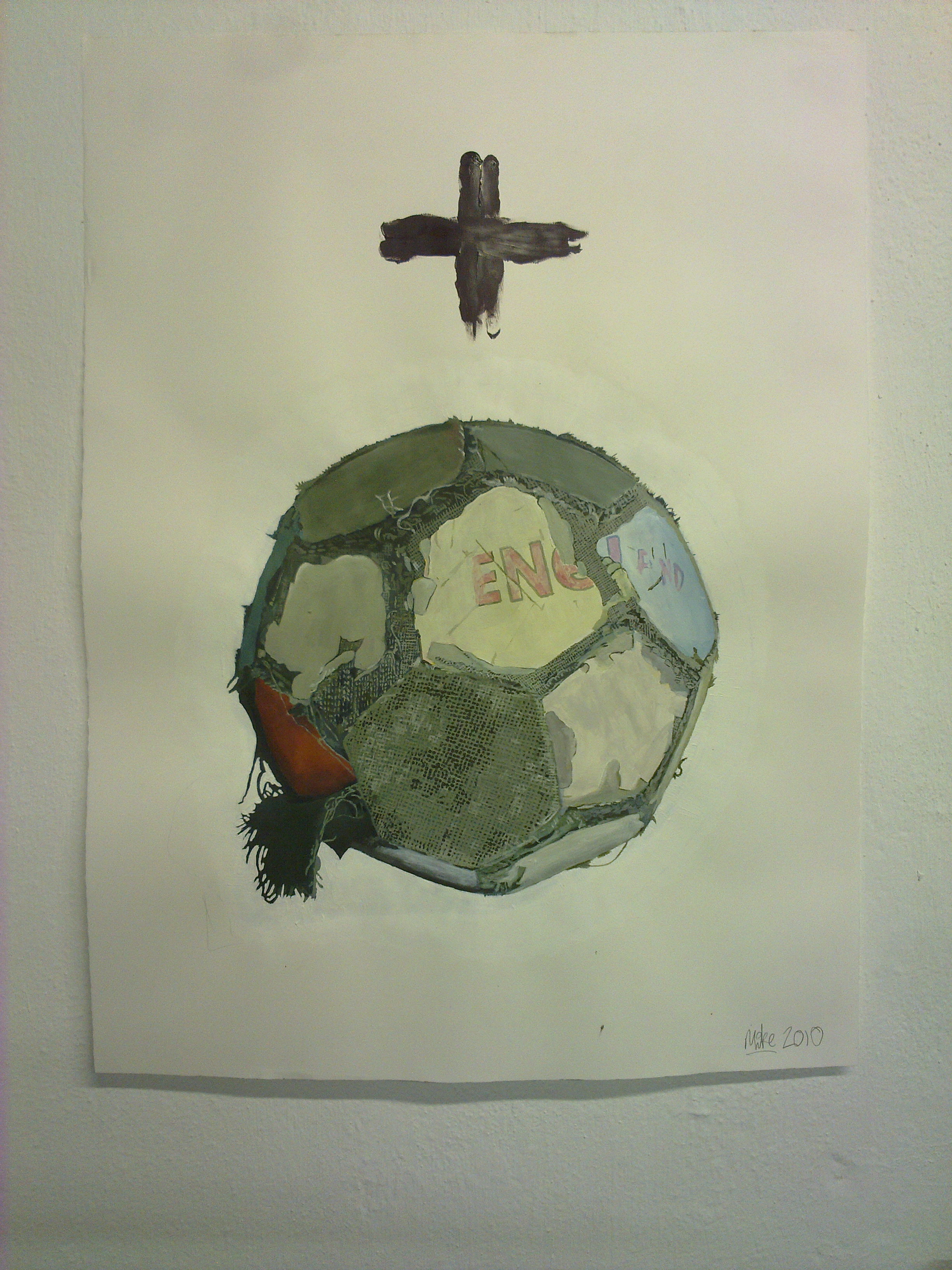
Called “Globus Cruciger”, it’s acrylic paint on paper, and it’s also a work that I’m very proud of. I’ve blogged about doing this before - it’s a football that I found abandoned on our estate. I did think about bouncing the actual football on the face of this painting 3,253 times – one bounce for every day that I’ve lived here. I liked the idea it could have a narrative to it, as well as a therapuetic side, and I was curious to see what effect it would have on the paper and the paint. However, I think I like the painting too much. If you click on the image and look at it a bit bigger, you’ll see that I’ve really put a lot of work in on the fine detail of the painting.

Empty Shops and YBAs

Monday, July 5th, 2010

I seem to have got myself involved in a rather exciting project this week. On Wednesday I’ll be going to do some work on a project called “Seven Days in Seven Dials” for the Empty Shops Network. Although I’ve already blogged about the basics of Empty Shops elsewhere, I thought there was another connection worth exploring.

Waaay back in the early 90s, about the time that I was leaving college, Damien Hirst and a few other were organising art shows in derelict spaces. Fresh out of Goldsmiths College, they were doing what the Empty Shops Network are doing now – taking a derelict space, and turning it into an art space with the support of the landlord, for little or no money as a means of showing off the space. Bringing life and excitement to an otherwise run-down area. Creating space for artists to show. The most well-known and well documented of these was a show known as Freeze.

Of course, as a young, newly graduated artist, this was music to my ears. Find an empty space, do it up yourself and bypass the need to find a gallery to represent you – galleries being a notoriously closed system that’s hard to break into.

BUT. What I kind of glossed over at the time, was that it was gallerists who were invited to Freeze. A lot of the talk was of democratizing the possibilities of arts exhibition spaces, and a part of me was excited that I could bypass my anxieties about meeting gallerists, by just doing it myself. However, I didn’t realise that if I was truly going to follow the plan, I would still have to talk to gallerists at some point. They weren’t just going to walk into my tarted-up space without any kind of connection just because the lights were now on and the space looked pretty. Of course, with a wide circle of friends, I could always guarantee a rent-a-crowd of mates, but most of them were as poor as me, and weren’t likely to buy anything.

But there was a further problem. Putting a derelict space to good use is all very noble, but what are the long term benefits? Did I really care about the area I was exhibiting in, and the people who lived there? Let me put it this way – was it fair of me to go in, put on a show, take the money and run? Wasn’t this a hit-and-run? A cultural form of rape, pillage and plunder?

Clearly I wanted and needed to be paid for what I was doing. That’s not an issue. But could it be possible to genuinely do some good as well?

It’s now some 20 years since the Freeze show, and most of the artists that were involved it are now mega-rich former YBAs, (What do you call a Middle-Aged former YBA? An MBA?)

But what of the idea of exhibiting in derelict spaces? I’m very proud to be involved with “Seven Days in Seven Dials” this week. I’ll be working with them all day Wednesday. Here’s a brilliant example of artists giving something rather than taking away. Working with unemployed people on work experience at some of the major institutions around London (Create KX, Design Council, English National Opera, Exhibition Road, The Hospital Club, National Portrait Gallery, the Royal Opera House, Somerset House and the V&A Museum), it gives them a chance to build their own picture of the area, and a voice to be heard. They’ll be creating psychogeography-style podcast audio tours around the area, as well as taking photos and creating art for an empty unused shop space.

Today has been the first day of activity, and I’m already excited by hearing that the first team of seven people have been sent out to do their stuff around and about. Lloyd Davis has also shot a few photos and uploaded them to Flickr.

The thing will develop and grow over the next 7 days culminating in a show which will run from Saturday 10 July until Friday 23 July 2010. You can go in right now though, and look at it all before then.

If you want to keep up with things online and can’t get there in person, then best way is to follow the #7days7dials hashtag. If you search that hashtag out on Twitter, you’ll find all the people involved (including me) doing their thing and there are plenty of interesting people to follow.

Art & Language: Social media and conceptual art

Monday, June 14th, 2010

I am deeply divided over painting.

When I was at art college, the idea of “skill” and “technique” was definitely a no-no. Ideas were everything. Concepts. Deep discussions with furrowed brows. That sort of thing. “Skill”, so the argument went, is something or someone that can be hired in to execute the idea for you. You don’t need to learn technique, and you should be more like a CEO, calling the shots and making the work happen. At push, you could actually paint with your own hand if you wanted to – but that was really just another stance; an idea about statement of intent. No one was interested in how amazing it was that someone could paint like that. The discussion straight away became about why you would want to do that in the 20th Century (yes it was that long ago that I went to art college).

Indeed, many major works are fabricated by Mike Smith, who I met on many occasions when I worked for a Fine Art storage firm back in the 90s.

When people used to ask me what sort of painting I did, it was never an easy question to answer. My favourite gag, and what I used to tell people, was that I did painting in inverted commas – I did “painting” rather than painting. To that end, I never really got down and sharpened up a technique. I’ve made a good fist of using a paint brush over the years, but I could have been a whole lot better at it if I’d made more of an effort to brush up on the skills required, if you’ll pardon the pun.

Part of the reason I’ve never really got the painting down as well as I might is that to some degree I agree with the above thesis. Ideas are important to work. I always wanted to be able to have ideas and concepts that I could do in any medium. I wanted the final works to be dictated by the idea, where ever it would take me. You can see, I hope, that if one had an idea that required a photographic representation of something, then one should probably just take a photo, rather than trying to paint like a photo (for example) purely because one is A Painter, otherwise it becomes about something different.

More than that, I didn’t want the skill of applying paint to a flat surface to be my schtick. Part of the allure, I think of art, any art, is that it takes you off into uncharted waters emotionally, intellectually, all sorts of ways – to the point where you should be able to forget about how it’s made. I would imagine that most people, when they’re listening to a piece of music, don’t spend the whole time listening out for the individual instruments or working out what notes are being played when. Rather, you let it wash over you as a cohesive whole.

However, as I’ve been involved in conversations with other artists online, I’ve noticed another perspective. Coming from a marketing point of view, it’s worth noting that using esoteric language is a classic example of “positioning”. It’s quite common to add value to something by talking it up. Put crudely, the more high-falutin it sounds, the more it’s considered serious and worthy of discussion. Clearly taken on this level, high-concept discussion add value to art works, and this could and does get used to increase the value to an artist’s work. The more sophisticated the better.

The flipside, of course, is that esoteric language is also a good way of keeping people out – anyone who doesn’t speak the lingo can quickly find themselves on the outside looking in, rather than the other way around. On the face of it, you might wonder why anyone would want to keep people away (surely you want to sell your work?) However, in fact the reverse happens – it makes people more curious. Like a group of people gathered round an accident, more people will come over to find out what it’s all about if they can’t quite make out what’s going on. Human nature.

A lot of the artists I’m meeting online seem to want to eschew the whole high-concept thing. Part of an Old Boys Club, they say. In a time when the internet is blowing open opportunities for artist to get their work out there and get on, its as if anything that indulges in deep concepts is “The Old System”, as if to say we need to be free of depth as well as the restraints of a closed system.

Personally I don’t buy it.

What I aspire to (and we can talk about how successful I am later) is that the same piece of work can be as complicated or as simple as you like. It should be possible to be able to look at work on a straightforward visceral level, but also to be able to go deeper should you want to – as deep as you like.

I’ve no doubt that using language to create a closed shop goes on, just as I have no doubt that that same language is sometimes used for “positioning”. However, I would argue that some people come to art FOR the depth, rather than in spite of it. It’s part of the allure, and there’s nothing wrong with it per se. Social media and art are both about connecting with an audience, and if that is your audience, then you’d be a fool to avoid it. Art should be more universal than that anyway.

Where does that leave me on the technique/conceptual continuum? I honestly don’t know. In fact I was hoping that I’d have a clearer idea by the time I’d finished writing this, but my suspicion is that it’s a false dualism/polemic/dialectic/dichotomy/how ever you want to put it.

Many artists such as Tracey Emin (check out the monoprints – much better than the tent or the unmade bed), Gary Hume, or Chris Ofili (who I recently reviewed here for his show at the TATE) have been very successful by developing a signature language – their own recognisable style that comes from skill and hard work (I recognise that all these people have technicians working for them, but the style is theirs, and was more than likely developed by their own hand to start with). Many of these artists also are able to talk about their works in quite a sophisticated way, too. All of them have been able to cross the boundaries between High Art, and the Common People (and no, that is not MY dualism).

As for me… Now, where did I put that paintbrush?

Cruciform painting

Saturday, May 29th, 2010

I had a good day in the studio yesterday. It took a while for me to get the confidence back, with me spending about 2 hours in a state of extreme agitation, staring at a half-started work before even being able to pick up a brush.

However, this work was one I started last year, so it helps me to know that I can do work when I get there.

This is based on a photo I took of myself. The image was then taken into Photoshop, and broken down into simpler colours. I then painted the simplified version of that photo. Once it was dry, I re-did the picture in Photoshop again, this time with slightly more complicated colours, and then repainted the whole thing over the top. This means that there was lots of nice underpainting that gives the work a healthy complexity and a “glow” from below.

I then repeated this process again a few times, building the painting up layer by layer. This is not the last layer, but it is the penultimate layer. The whole thing is done with acrylics, and the paint is quite thin – I like the flatness of the surface, rather than the built up thickness that you get with oils.

It’s painted on a piece of board that I found. I really think that in order for a work to exist in the world, it needs to justify its existence from an ecological point of view. There are already too many objects in the world – too much junk. So from now on, I’m going to start painting on and with stuff that I’ve found. There’s enough of it lying around where I live – people dump all sorts of rubbish (wardrobes, cupboards, etc.) with lots of flat surfaces to paint on. While this painting that I’m doing looks rather traditional, it won’t be when I’ve finished with it. I’ve barely started in fact.

Now I just need to order those red LED fairy lights for it…

Art, Social Media and Art Institutions

Saturday, May 15th, 2010

One of my particular bugbears about art shows is the amount of information that is often to be found crowding the works.

The TATE is particularly guilty of this – each room has a wall of writing, in addition to the leaflet you’re given to take with you round the room, and the catalogue to buy, as if the title of a work next to it wasn’t enough. And then there’s the little knee-high fences, that are supposed to stop you getting too close to the painting, while the jumpy security guards shuffle around following you in case you breathe too heavily.

I went to see the Chris Ofili show at the TATE Britain last week, in the last few days before it closed, and the levels of control reached a new and irksome height.

Before you even got in the show, there was a sign saying “No mobile phones, No cameras.”

Now, the issue with all this stuff is that it prevents the work from breathing. At the end of the day, a description of an artist’s work is essentially one person’s interpretation, ie. Not Yours. Straight away, we’re into a massive contradiction here. The TATE is supposed to be a public space, and yet there is an issue of neutrality around an interpretation of a work, especialy when the organisation hosting the show belongs to the state. Couple that with the fact that you’re being charged to get in to that part of the public space as well, and the mixed messages start to pile up higher than the Duveen Gallery’s cavernous ceiling.

Coming back to the “no mobile phones” sign. I quite like to use Twitter when I’m walking around a show. It’s a good way of collecting my thoughts with regards to certain paintings, it’s also a record of those thoughts that I can refer back to when I get home, and you can end up getting into some nice debates with other Twittists while you’ve got the work in front of you. Now, of course the idea that someone might use that camera phone to snap a picture of the work does creep in, but there’s a problem right there….

As I tweeted at the door to the show @tate (BEFORE I went in if you’re reading this Mr. Serota), tweeting about a show will make people more interested in it, and ultimately lead to more people through the door of the TATE, more bums on seats of the cafĂ©, more catalogue sales, etc., etc. To stop people getting phones out in a show is a stupid shot in the foot for the gallery. And let’s (briefly) address the subject of taking photos in art shows. Instead of preventing people taking photos, why not default to the usual public space idea of no photos by anything that requires a tripod? That way, people would still take photos, and although the quality of those photos might be lower, it would necessarily draw people to come and look at the art, as everyone knows that no photo comes close to the actual experience of standing personally in the prescence of a piece of work – to actually be physically in the same space as the work. Also consider – if you took one really good photo of one of Chris Ofili’s paintings, reproduced it, and mass-distributed it for free, then I would lay a bet with you that that show would be more talked about, more on people’s fridges, workspaces and personal environments than ever before, and more visited than any other show in the history of the TATE. If I was to take a photo with my cameraphone, and make that picture my desktop, then every single one of my friends who saw my laptop would want to know all about it, and most likely go and see the show.

However, I know that this idea, should anyone from the TATE or any other major art institution be reading this, will probably be met with derision for very deeply ingrained reasons. Part of the drama, allure and value of the art world as it stands, is the fact that it is a secluded, hushed, and esoteric space that only the elite can sample. Art is a poker face. Art is method acting – the theatre and illusion, much like the actor who pretends to be something special for an audience, but goes home to a very ordinary life. The bigger the stature of the artist, the more essential it becomes to maintain that poker face.

Now don’t get me wrong, I love the sense of drama, and I think that’s what people like about art and art shows – aside from some sense of visceral enjoyment, there is a kudos it gives you from saying “Oh yes, I went to an art show the other day.” It’s a social marker, an attitude, a crowd.

Any attempt to take a picture by the public bursts that bubble. It undermines quality control (how good is that image you taken? How many megapixels does your camera have?), and the proliferation of interactions by you and me, brings art down from it’s lofty heights (and dare I say it from the lofty prices of private collectors and high-end art dealing) into the Real World.

My point is that essentially this spoilt the show for me. This maelstrom of information overload and heavy-handed officiousness made it very hard for me to look at the work with a clear head, as the intense level of control essentially de-mystified the work – it had the opposite effect to the desired one! I was somehow reminded of the pieces’ construction and humble beginnings, somehow belittling them, drawing attention away from their drama and theatre instead of adding to it.

I tried really hard to shake myself free of this, but once something has been demystified in such a crass, un-thinking and haphazard way, it’s hard to get the genie back in the bottle.

The other part where I have a problem is the political intrusion of the TATE’s writings. Remember the TATE was founded on the back of the sugar industry. Sugar from slave labour. Much like the British Empire as a whole. The descendents of whom own the TATE gallery. The irony of one of Britain’s greatest artists, indeed a black artist, being mediated by writings by this British state (responsible for some of the most heinous crimes known against black people) in this way is so heavily loaded in so many different ways it gives me a headache. And no, I don’t think it’s just my white guilt.

It’s a shame, because I KNOW that Ofili’s Upper Room is a good piece of work, but all the other political stuff spoilt it for me, which is not Ofili’s fault at all. I’d love to be able to review this show, but I can’t clear my head enough to do so.

All of this leaves me wondering about my place in things, and how I want to proceed with my own working practise. Clearly I don’t have the clout to position myself in the same league as Chris Ofili. But a part of me wonders why I should want to? I can’t think of a good enough reason to want to be owned by an elite group of collectors other than greed. I could walk the walk and talk the talk, ring fence my work and talk about it in hushed, elevated tones, or I could try something else.

I’m not sure what I’m driving towards, but there’s something about the art that is more powerful when it’s found in the ordinary. In the act of sharing work and the stories behind those works, in proliferating them by re-sharing those extraordinary artistic moments as they happen through the channels available to me. I’d really rather that, than letting my works ossify in some glass cabinet somewhere.

As for the Chris Ofili show – it finishes tomorrow. A missed opportunity for a great, great artist.

Working again. Maybe.

Wednesday, May 12th, 2010

I have a confession to make. I struggle.

Being an Artist. I hate it. I have always found it hard to even start working. To make the first mark – any mark. I don’t know why this is. Well, I do know why actually. A mixture of anxiety issues, mental health stuff, and too many other commitments going on. I have a show in Brixton later this year. In July. It’s the Urban Art Fair that I did last year. July is not so far away now, and yet I haven’t done any work for it. Every fibre of my being is screaming inside my head “DO SOME DRAWING! START SOMETHING! ANYTHING!” and yet every day that passes is filled with a mixture of the genuine demands, procrastination and avoidance. And still no art appears.

I’m not one of these artists that thrives on being a “disturbed genius”. In fact it’s one of those myths that I despise. The reality is that having mental health issues prevent you from working and creating. They don’t feed creativity, any more than any other life’s work. Being anxious wouldn’t help you be better accountant, and it certainly doesn’t help me make art.

I wish I was like a Hugh MacLeod or a Hazel Dooney. Hugh’s prodigious output is a part and parcel of his expertise and it shows. He’s put the hours in. Hazel has battled far worse mental health issues than I ever will, and still keeps getting up and fighting on, like the true prize fighter she is.

If I had a shred of their determination, discipline and drive, I would be much more successful than than I am. I take great confort from stories of Douglas Adams’ working method. As a writer he was the most painful of procrastinators. He was renowned for agonising up to the last minute. He would not put one mark on a piece of paper until two weeks before the deadline from his publisher, then he locked himself away for two weeks and dashed out some of his most well known and famous works, and even then he had to be cajoled and coerced into it. Stories like this give me hope.

I’m being honest about this in the hope that the humiliation of such a public declaration will drag me out of this torpor and start me working again.

The football in the photo above was left outside our flat, by the kids that play on our estate. I’ve already done work about the various issues surrounding the place where I live, which you can read about in various parts of my blog.

They often leave things behind to collect hours, even days later. They see the area as “theirs”. I commandeered the football early one morning – long before they were up to notice – at 6 in the morning. I’m going to draw it, paint it and photograph it. You can’t invent a football like that. It has so many stories and possible meanings, especially with the upcoming football World Cup in South Africa this summer.

When I’m done, the kids can have the football back.

We’ll see whether this will get me working again.

Damien Hirst at The Wallace Collection

Thursday, January 14th, 2010

Today, I finally managed to get to The Wallace Collection in the heart of London to see Damien Hirst‘s latest show, “No Love Lost”

The show marks a departure for Hirst, as he attempts to paint using oil paints by his own hand, rather than the style that has made him famous – usually executed by a trained army of technicians. As such I had high hopes for this show, as I was interested to see where Damien, a sculptor in the broadest sense, could take my discipline (“painting”).

Sadly I have to say I was distinctly unimpressed. I don’t say “unimpressed” in the throwaway sense, I mean that i was waiting for something about his paintings to impress something upon me. Nothing did.

I was not impressed by his draughtsmanship. There was nothing about the trees in particular that suggested any degree of mastery, the lemons looked flat and impact-less, and the best-rendered objects (the skulls) had no impact on me at all.

I was not impressed by any conceptual thinking. There is clearly some attempt at memento mori going on here, and the recurring motifs of his previous work suggest a man reflecting on the vanity of his career. But that’s about it. Not enough to sustain a body of work, not even for a whole show. There’s more than a nod to the work of Francis Bacon here, but to what end?

I’m not impressed by his technical ability. Some of the priming underneath the paint on one or two of the canvases has clearly cracked and curled in away that strikes me as too inept to be intentional.

I wasn’t scared by them, I wasn’t intimidated by them, I wasn’t amused by them… nothing.

My feeling is that they’re not good enough to show yet. Given Hirst another 5-10 years of painting, and then they might be good, but for me the only work worth looking at was the one labeled No. 2 Title: “Small Skull With Lemon and Ashtray.” You could quite conceivably walk in, look at that painting and walk straight out again. It would tell you all you need to know about this show, without you having to be disappointed by the rest of it.

Many years ago, the artist Gary Hume had a pop at Hirst’s inability to understand a few home truths about his work. With a wink and a smile, he said something along the lines of “Well, he’s not a painter, so he wouldn’t understand!” On the strength of this show, I’d have to say that Hume is right.

I have to confess to being a bit of a fan of Hirst’s work, and I really wanted to like this show, but I didn’t. I’m happy, though, for him to continue working like this in anticipation that he’s going to get better at it. Here’s hoping.

Collecting Art

Thursday, January 7th, 2010

For Christmas this year, I got my first ever original work by an artist. It’s a signed lithograph by the artist Sarah Sze, called “Funny Feeling” from 2004, and it looks like this:

sze

Actually that’s not quite true. It’s not my first work. About two years ago, my brother-in-law got hold of a piece of work by Bill Drummond for me (for free) and at the Greenbelt Festival 2009, I managed to get a limited edition lithograph by Billy Childish.

However, the Christmas present feels like the first “proper” attempt at getting someone else’s work, as it was bought and paid for (although not by me) rather than a freebie. And it was a first conscious effort to get start “A Collection”. Does 3 works count as “A Collection”? I’m not really sure.

I really like this piece. A lot. I like lithographs very much – there’s something about the resulting image that only lithography can deliver. I like the mark-making. Sarah Sze’s work often displays a deftness and a delicacy which is exquisite. It also has a precision which is quite mechanical in a way that I can’t put my finger on.

It’s hard to know where to start when buying original work. Clearly it has to be something you like first and foremost. If you take nothing else away from what I write here, at least take that to heart. It doesn’t matter why you love it – that’s up to you. You may like the marks the artist makes, the over all look of the piece, you may like the ideas behind it – you may just like it because it goes with the wallpaper in your living room. It doesn’t matter. Just don’t buy to speculate. Speculating is a murky water that is tantamount to betting on horses. If you’re good at betting on horses, and you would like to branch out into art – good luck. I can offer you no advice in that direction.

In terms of where to start looking, I noticed that a lot of big name galleries were selling limited edition works by reasonably well known artists. I got my Sarah Sze lithography from The Serpentine Gallery, who have a number of works for sale, but from there I noticed that the Whitechapel Gallery were also doing some and, to a lesser extent even the TATE were getting in on the act.

BUT.

Before you part with your hard-earned cash, there’s something I think you should know. I’m sorry to spoil this conversation with talk of Mammon, but most galleries take a cut from the sale of any work, and it’s a pretty big one: 50% of the sale goes to the gallery. No that is not a typo error. You heard me correctly. In some cases it can be as much as 60-70%. There are all sorts of reasons and justifications as to why that is, and the best summary/justiciation of that that I’ve read can be found over at Ed Winkleman’s blog. I don’t actually believe that that level of commission is justified for various reasons but I will save that for another blog post. Feel free to agree or disagree.

Back to Sarah Sze, though – I got her work not to speculate on the art market or anything like that, but there is something that feels a little more “valid” about getting the works from such august institutions. You can go to something like the Affordable Art Fair, or the upcoming London Art Fair and find a rather than being bewildered by the array on offer there, but clearly there is an “aura of the art world”, and what is considered to be culturally significant. It raises all sorts of questions about who says what’s valid, and why. All I know is that I feel that “pull” as someone who is immersed in the culture as a practitioner.

There are, however, plenty of artists that I know and respect as friends who do some outstanding work, and I would love to own a piece of theirs – I’ll endeavour to do so as soon as funds allow. I would recommend this approach, especially if you don’t want to support the gallery system. It puts money straight into the artists hands, and you’ll also have the satisfaction of being philanthropic and picking up a bargain before the value of the work goes up. There are some great people out there, and most if not all would appreciate a studio visit, if you want to look at the work in the flesh.

So there you have it. Now I just have to save some pennies to frame the one I’ve bought, and we’re away.

Linocutting and the Cutting Edge

Monday, January 4th, 2010

Happy New Year, and welcome back to the artbizness blog for 2010. This year, I hope to be doing a lot more paintings, and branching out a bit more into other media where I can. I also have a few large projects that I’m thinking about. More of that soon, but here’s what I’m thinking and doing at the start of the New Year:

This Christmas I got some Lino-cutting tools as a present from my Mother-in-law. i haven’t done any lino-cutting for about 20 years, but I do remember really enjoying it when I did. I suppose I’ve avoided it for a long time, as it seems quite retro. Here’s an example of a linocut work:

As you can see – it’s a great piece, but it’s not exactly my style. Like a relic of an old dead media, it seems a bit too much like a “craft”, and is a world away from anything by someone like Damien Hirst, for example. When I was at art college the idea of the “cutting edge” art was drummed into you. Words such as “vanguard”, and “avant garde” were banded about without being really questioned. Likewise, words like “craft” and “creativity” were dismissed. I think you can still see these ideas having a lot of currency in the contemporary art world and its culture.

However, those old ideas of what’s “dead media” or not interest me less and less. I think with anything, you have to throw yourself in wholeheartedly. The idea of the avant-garde is a great way of trying to convince yourself why NOT to do something. It stifles action if you’re tied to this idea of only doing things that are cutting edge. It leads you to dismiss avenues that are not cutting edge enough, rather than just trying things out to see where they take you.

Of course this brings up all sorts of ideas about what is “good” and why, and who decides what is avant-garde, but that’s out of the scope of this blog post.

So I’m going to give linocutting a go and see where it takes me. And that idea feels quite liberating already.

Here’s how it works: Get a piece of lino, and some sharp sharp lino cutting tools that look like this:

lino

As you can see from the photo, I’ve already cut my thumb just trying to put the sharp nib into the handle, so take great care when you’re using these things.

Decide what image you want to print and draw it onto the lino mat. Just remember that the image that you are doing will come out in reverse when you print it. Also – the bit’s that you’re gouging out will not print, so you are sort of creating the image in negative, if you see what I mean. It will print out “not-in-negative”, as it were.

When you’ve finished carving out your piece of lino (mind your fingers!), you roll some paint onto it, then carefully place a piece of paper flat on top of it.

Now. At this point you will either need a massive lino press, which is a specialised piece of equipment and jolly expensive, or some very heavy books and something to weight them down with. So which ever it is, press the paper onto the lino.

When you’re done, take it out of your press/weighted books, and peel the paper off the lino. There’s your printed masterpiece.

Now, if you really want to get clever, you can use a few linos to build up a complicated composite image with lots of different colours. But that’s fiddly and requires a bit more skill and planning.

So there we are. I’ll be trying that soon and posting my results here as soon as I’ve done it.

Trying out the acrylic paint

Wednesday, September 9th, 2009

Christ

I want you to get more value from my paintings.

Sometimes I wonder what you see when you look at my work. Do you see years worth of experience accumulated in the work? Do you see master craftsmanship? Do you have an un-nameable emotional reaction when you see my work?

This piece of wood has been kicking around my apartment for months now, and the other night I started painting on it. It’s the sort of piece of wood that you might throw away when you’ve finished working on your house. A nice offcut. Flat and smooth, with some nice grain patterns on it.

I have no idea where this work is going – it’s more like a practise piece. I’ve taken a photo of myself (and no, I have no messiah complex, but I do seem to be crucified every time I do anything) then pulled it into Photoshop. If you use the “posterise” feature, it reduces the number of colours in the photo.

So I thought that if I reduced the number of colours to 4, and painted that, then reduced the number of colours to 8, and painted that over the first one, then eventually I could build it up over time, so that it looks dense and translucent when you look at it.

This is all done pretty freehand though, with a vague attempt at gridding it up, and sketching it out in pencil first.

If you yourself ever put brush to wood/canvas/board, you’ll know that making a work is a voyage of discovery. When drawing your arms, you just couldn’t believe you are that muscley, as in your head, you’re always the skinny kid from school. You realise you can’t draw hands. You notice that the paint soaks into the wood if you haven’t primed it in some way, but you then think that it might be fine because it gives it a ghostly feel. And so on.

But I think that you the viewer wants to know that for every painting that you see from me, there are probably hundreds like this one, that may never see the light of day – that are the duds, the throwaways. That the ones you do finally get to see are the best of the best.