Archive for the ‘general’ Category

Art & Language: Social media and conceptual art

Monday, June 14th, 2010

I am deeply divided over painting.

When I was at art college, the idea of “skill” and “technique” was definitely a no-no. Ideas were everything. Concepts. Deep discussions with furrowed brows. That sort of thing. “Skill”, so the argument went, is something or someone that can be hired in to execute the idea for you. You don’t need to learn technique, and you should be more like a CEO, calling the shots and making the work happen. At push, you could actually paint with your own hand if you wanted to – but that was really just another stance; an idea about statement of intent. No one was interested in how amazing it was that someone could paint like that. The discussion straight away became about why you would want to do that in the 20th Century (yes it was that long ago that I went to art college).

Indeed, many major works are fabricated by Mike Smith, who I met on many occasions when I worked for a Fine Art storage firm back in the 90s.

When people used to ask me what sort of painting I did, it was never an easy question to answer. My favourite gag, and what I used to tell people, was that I did painting in inverted commas – I did “painting” rather than painting. To that end, I never really got down and sharpened up a technique. I’ve made a good fist of using a paint brush over the years, but I could have been a whole lot better at it if I’d made more of an effort to brush up on the skills required, if you’ll pardon the pun.

Part of the reason I’ve never really got the painting down as well as I might is that to some degree I agree with the above thesis. Ideas are important to work. I always wanted to be able to have ideas and concepts that I could do in any medium. I wanted the final works to be dictated by the idea, where ever it would take me. You can see, I hope, that if one had an idea that required a photographic representation of something, then one should probably just take a photo, rather than trying to paint like a photo (for example) purely because one is A Painter, otherwise it becomes about something different.

More than that, I didn’t want the skill of applying paint to a flat surface to be my schtick. Part of the allure, I think of art, any art, is that it takes you off into uncharted waters emotionally, intellectually, all sorts of ways – to the point where you should be able to forget about how it’s made. I would imagine that most people, when they’re listening to a piece of music, don’t spend the whole time listening out for the individual instruments or working out what notes are being played when. Rather, you let it wash over you as a cohesive whole.

However, as I’ve been involved in conversations with other artists online, I’ve noticed another perspective. Coming from a marketing point of view, it’s worth noting that using esoteric language is a classic example of “positioning”. It’s quite common to add value to something by talking it up. Put crudely, the more high-falutin it sounds, the more it’s considered serious and worthy of discussion. Clearly taken on this level, high-concept discussion add value to art works, and this could and does get used to increase the value to an artist’s work. The more sophisticated the better.

The flipside, of course, is that esoteric language is also a good way of keeping people out – anyone who doesn’t speak the lingo can quickly find themselves on the outside looking in, rather than the other way around. On the face of it, you might wonder why anyone would want to keep people away (surely you want to sell your work?) However, in fact the reverse happens – it makes people more curious. Like a group of people gathered round an accident, more people will come over to find out what it’s all about if they can’t quite make out what’s going on. Human nature.

A lot of the artists I’m meeting online seem to want to eschew the whole high-concept thing. Part of an Old Boys Club, they say. In a time when the internet is blowing open opportunities for artist to get their work out there and get on, its as if anything that indulges in deep concepts is “The Old System”, as if to say we need to be free of depth as well as the restraints of a closed system.

Personally I don’t buy it.

What I aspire to (and we can talk about how successful I am later) is that the same piece of work can be as complicated or as simple as you like. It should be possible to be able to look at work on a straightforward visceral level, but also to be able to go deeper should you want to – as deep as you like.

I’ve no doubt that using language to create a closed shop goes on, just as I have no doubt that that same language is sometimes used for “positioning”. However, I would argue that some people come to art FOR the depth, rather than in spite of it. It’s part of the allure, and there’s nothing wrong with it per se. Social media and art are both about connecting with an audience, and if that is your audience, then you’d be a fool to avoid it. Art should be more universal than that anyway.

Where does that leave me on the technique/conceptual continuum? I honestly don’t know. In fact I was hoping that I’d have a clearer idea by the time I’d finished writing this, but my suspicion is that it’s a false dualism/polemic/dialectic/dichotomy/how ever you want to put it.

Many artists such as Tracey Emin (check out the monoprints – much better than the tent or the unmade bed), Gary Hume, or Chris Ofili (who I recently reviewed here for his show at the TATE) have been very successful by developing a signature language – their own recognisable style that comes from skill and hard work (I recognise that all these people have technicians working for them, but the style is theirs, and was more than likely developed by their own hand to start with). Many of these artists also are able to talk about their works in quite a sophisticated way, too. All of them have been able to cross the boundaries between High Art, and the Common People (and no, that is not MY dualism).

As for me… Now, where did I put that paintbrush?

Art, Social Media and Art Institutions

Saturday, May 15th, 2010

One of my particular bugbears about art shows is the amount of information that is often to be found crowding the works.

The TATE is particularly guilty of this – each room has a wall of writing, in addition to the leaflet you’re given to take with you round the room, and the catalogue to buy, as if the title of a work next to it wasn’t enough. And then there’s the little knee-high fences, that are supposed to stop you getting too close to the painting, while the jumpy security guards shuffle around following you in case you breathe too heavily.

I went to see the Chris Ofili show at the TATE Britain last week, in the last few days before it closed, and the levels of control reached a new and irksome height.

Before you even got in the show, there was a sign saying “No mobile phones, No cameras.”

Now, the issue with all this stuff is that it prevents the work from breathing. At the end of the day, a description of an artist’s work is essentially one person’s interpretation, ie. Not Yours. Straight away, we’re into a massive contradiction here. The TATE is supposed to be a public space, and yet there is an issue of neutrality around an interpretation of a work, especialy when the organisation hosting the show belongs to the state. Couple that with the fact that you’re being charged to get in to that part of the public space as well, and the mixed messages start to pile up higher than the Duveen Gallery’s cavernous ceiling.

Coming back to the “no mobile phones” sign. I quite like to use Twitter when I’m walking around a show. It’s a good way of collecting my thoughts with regards to certain paintings, it’s also a record of those thoughts that I can refer back to when I get home, and you can end up getting into some nice debates with other Twittists while you’ve got the work in front of you. Now, of course the idea that someone might use that camera phone to snap a picture of the work does creep in, but there’s a problem right there….

As I tweeted at the door to the show @tate (BEFORE I went in if you’re reading this Mr. Serota), tweeting about a show will make people more interested in it, and ultimately lead to more people through the door of the TATE, more bums on seats of the café, more catalogue sales, etc., etc. To stop people getting phones out in a show is a stupid shot in the foot for the gallery. And let’s (briefly) address the subject of taking photos in art shows. Instead of preventing people taking photos, why not default to the usual public space idea of no photos by anything that requires a tripod? That way, people would still take photos, and although the quality of those photos might be lower, it would necessarily draw people to come and look at the art, as everyone knows that no photo comes close to the actual experience of standing personally in the prescence of a piece of work – to actually be physically in the same space as the work. Also consider – if you took one really good photo of one of Chris Ofili’s paintings, reproduced it, and mass-distributed it for free, then I would lay a bet with you that that show would be more talked about, more on people’s fridges, workspaces and personal environments than ever before, and more visited than any other show in the history of the TATE. If I was to take a photo with my cameraphone, and make that picture my desktop, then every single one of my friends who saw my laptop would want to know all about it, and most likely go and see the show.

However, I know that this idea, should anyone from the TATE or any other major art institution be reading this, will probably be met with derision for very deeply ingrained reasons. Part of the drama, allure and value of the art world as it stands, is the fact that it is a secluded, hushed, and esoteric space that only the elite can sample. Art is a poker face. Art is method acting – the theatre and illusion, much like the actor who pretends to be something special for an audience, but goes home to a very ordinary life. The bigger the stature of the artist, the more essential it becomes to maintain that poker face.

Now don’t get me wrong, I love the sense of drama, and I think that’s what people like about art and art shows – aside from some sense of visceral enjoyment, there is a kudos it gives you from saying “Oh yes, I went to an art show the other day.” It’s a social marker, an attitude, a crowd.

Any attempt to take a picture by the public bursts that bubble. It undermines quality control (how good is that image you taken? How many megapixels does your camera have?), and the proliferation of interactions by you and me, brings art down from it’s lofty heights (and dare I say it from the lofty prices of private collectors and high-end art dealing) into the Real World.

My point is that essentially this spoilt the show for me. This maelstrom of information overload and heavy-handed officiousness made it very hard for me to look at the work with a clear head, as the intense level of control essentially de-mystified the work – it had the opposite effect to the desired one! I was somehow reminded of the pieces’ construction and humble beginnings, somehow belittling them, drawing attention away from their drama and theatre instead of adding to it.

I tried really hard to shake myself free of this, but once something has been demystified in such a crass, un-thinking and haphazard way, it’s hard to get the genie back in the bottle.

The other part where I have a problem is the political intrusion of the TATE’s writings. Remember the TATE was founded on the back of the sugar industry. Sugar from slave labour. Much like the British Empire as a whole. The descendents of whom own the TATE gallery. The irony of one of Britain’s greatest artists, indeed a black artist, being mediated by writings by this British state (responsible for some of the most heinous crimes known against black people) in this way is so heavily loaded in so many different ways it gives me a headache. And no, I don’t think it’s just my white guilt.

It’s a shame, because I KNOW that Ofili’s Upper Room is a good piece of work, but all the other political stuff spoilt it for me, which is not Ofili’s fault at all. I’d love to be able to review this show, but I can’t clear my head enough to do so.

All of this leaves me wondering about my place in things, and how I want to proceed with my own working practise. Clearly I don’t have the clout to position myself in the same league as Chris Ofili. But a part of me wonders why I should want to? I can’t think of a good enough reason to want to be owned by an elite group of collectors other than greed. I could walk the walk and talk the talk, ring fence my work and talk about it in hushed, elevated tones, or I could try something else.

I’m not sure what I’m driving towards, but there’s something about the art that is more powerful when it’s found in the ordinary. In the act of sharing work and the stories behind those works, in proliferating them by re-sharing those extraordinary artistic moments as they happen through the channels available to me. I’d really rather that, than letting my works ossify in some glass cabinet somewhere.

As for the Chris Ofili show – it finishes tomorrow. A missed opportunity for a great, great artist.

Breaking Through Your Creative Blocks

Monday, March 15th, 2010

For quite a while now, I’ve been an avid follower of the blog over at Lateral Action.

Lateral Action is a brilliant resource for anyone working in any kind of creative industry (as I do) – a treasure trove of useful information, running series of posts on various topics, and links to stuff designed to help the often difficult process of birth great works of art. Even if “great works of art” ain’t your thing, you would do well to take a look as I’ll bet most people could do with the extra skills needed to get by in the world of work no matter what you do, especially at the moment. This blog provides great food for thought, and is run by the very lovely MarkMcGuinness, who I’ve had the good fortune to meet a few times.

Like most artists I experience various “creative blocks” along the way as I’m trying to do my work. Everyone gets them, and they tend to manifest them in personal ways. However, recently Mark asked for people to submit their own particular “creative blocks” in order for him to tackle them head-on in a series of blog posts. I’d never turn down the opportunity for some free coaching, so was very pleased to find that Mark and Marelisa Fábrega (another some-time contributor to Lateral Action) picked up on both the creative blocks that I sent in. You’d be surprised how many other people share your particular creative blocks…

The two I sent in in particular are these:

Creative Block #4 – Creativity v Cash

Creative Block #6 – The Inner Critic

However, if you want to read the whole series (and I would thoroughly recommend that you do) then you can go back and read through the list of titles – they’re all there:

  1. Tell Us Your Creative Blocks – and We’ll Help You Smash Through Them!
  2. Creative Block #1 – “I’m Not Creative”
  3. Creative Block #2 – Fear of Getting It Wrong
  4. Creative Block #3 – Lack of Time
  5. Creative Block #4 – Creativity v Cash
  6. Creative Block #5 – Being Disorganised
  7. Creative Block #6 – The Inner Critic

Enjoy.

The Myth of The Artist

Saturday, June 27th, 2009

I’ve just finished an extraordinary book called “Why are Artists Poor” by Hans Abbing. It was recommended to me by my Twitter buddy Ivan Pope. Although I think the book has an awful title, it has been so enlightening for me and has lead to a series of “lightbulb moments” about my profession. So much so that I’m going to write a series of blog posts that I hope will be useful for both artists and art-audiences alike.

I’d go so far as to say that this book should be required reading on all arts courses (especially the UK degree courses), as it’s a real wake-up call containing many home truths that all wanna-be artists would do well to take heed of.

The book argues that the economy of the arts is an exceptional one, and that it systematically keeps artists (of all types – painters, musicians, writers, etc.) poor, and that it is a cruel economy with no one culprit, but a series of relationships and values that maintain the situation as it is.

Abbing suggests that central to this economy is a series of myths that are so universally internalised, that they aren’t even consciously acknowledged. Have a little think about them. Do they stack up? Are they really myths or truths? Do you find that you think about artists this way?

I’ll write later about which of these myths I think need debunking, and which I think are not actually myths but reality. Some of these are contradictory, all thought provoking, but for now, here they are. If you want to add your thoughts in the comments box below, I’ll happily engage in discussion with you.

1. Art is sacred
2. Through art, artists and consumers relate to a sacred world
3. Art is remote and superfluous.
4. Art is a gift.
5. Artists are gifted.
6. Art serves the general interest.
7. Art is good for people
8. Artists are autonomous; other professionals are not autonomous.
9. There is freedom of expression in the arts
10. The work of art is authentic, and the artist is the unique creator of it; in other professions such authenticity does not exist.
11. Creating authentic work gives one endless private satisfaction.
12. Artists are selflessly devoted to art.
13. Artists are only intrinsically motivated.
14. Money and commerce devalue art.
15. Artistic quality can only exist if it is independent of costs and demand.
16. Artists have to suffer.
17. Talent is natural or God-given.
18. Everybody has the same chance of being gifted or talented.
19. Certain talents in the arts only appear later in someone’s career.
20. Because extraordinary talent is rare, only a large pool of artists can provide society with a few extremely talented artists.
21. Success in the arts depends on talent and commitment exclusively.
22. The arts are free. The barriers that exist in other professions are absent in the arts.
23. Successful artists are often self-taught.
24. Given talent and commitment, equal chances exist in the arts; the best is victorious.
25. Because the best win, the arts are democratic and righteous.
26. The high incomes earned by some artists are fair.

Building websites

Thursday, April 2nd, 2009

A photo of what the plumbizness.com website looks like

Hello out there.

I’m emerging blinking into the sunlight, as I have spent the past week or so constructing websites. It’s been an interesting learning-cliff-face, as I put myself through various crash courses in html and css. And no, before last week, I didn’t know what that meant either.

I’m thinking of moving this blog. I dearly love wordpress.com and have enjoyed it. However, there are some things that I can’t do with it that I would like to. This blog is basically hosted by wordpress. I need to self-host in order to be able to tweak things and put new things in.

So I’m going with wordpress.org!

Huh? I hear you cry. Didn’t you just say….?

Go back and read it more carefully. I can’t do what I want with wordpress.COM, but I can do what I want with wordpress.ORG. The .ORG version will sit on my own private webspace, and allow me to alter things how I want.

In fact, I’ve already tried a test run. Not everyone knows this (and I don’t generally talk about it here) but when I’m not being an artist, I’m a plumber. So I thought I would build a static website using wordpress.org as a sort of dry run for re-vamping artbizness.

The plumbing website is called www.plumbizness.com. That’s a photo of it at the top. Go take a look and let me know what you think.

In the meantime… I’ll be working on artbizness. I’m not going to move it just yet, but hopefully sometime over the next month. I’ll tell you where and when soon.

In the meantime – I will still post here. But consider yourselves on notice. :-D

A Free Print for my blog readers

Wednesday, January 7th, 2009

sorrowsthumb

Happy New Year everyone. I hope you had a good Christmas, and I apologise for not posting more regularly.

To make up for it, I’m going to start the year by offering some free artwork.

It’s a print of my most well-known and well-liked piece of work, called “Man of Sorrows”

Here’s the link.

There’s no catch. Just download it, and print it off.

Or turn it a postcard or a mugs or a t-shirt, or use it in a powerpoint presentation. Do what ever you want with it, as long as it’s for personal use. (I mean: no sneaky making money directly from it. That wouldn’t be fair now would it? I’ve just given it to you for free. Thanks :-) ).

The best thing I can suggest is that you take it to a printshop, and get them to print it (best size at A4 but no more than A3), then buy a nice frame for it, and put it on your wall.

Why am I doing this? As I said before. I’d far rather you had a piece of my work than not be able to afford one.

I want you to be able to have this in your space if you want it, and for it to move you, like it has moved me.

I made the work but it forced me to think about poverty and spirituality, and where those things can be found. It sat in my thoughts even when I wasn’t looking at it, a changed the atmosphere of every room I hung it in for the better. It made me think about transcendence and immanence, about art and life, and about sacred and profanity, and what am I doing about those things?

I guess that’s more important to me than being paid for the original. If you want to buy the original, then that’s a different story, but this is about the best quality photo I have of it, and I think it will give you all the things it gave me and a whole lot of other things that are specific to you.

Have a good 2009.

Beyond Addiction

Tuesday, September 2nd, 2008

Hmm.. this is frustrating….

For a while now, I’ve been toying with the idea of setting up an online shop – a central place where you can buy anything I do – and have been working quite hard at making some work to sell for a few days. Simple.. I thought.. Paypal.. no problem..

However, having just posted it all here, a friend has just pointed out that it’s a rather large violation of the Terms & Conditions of wordpress.com.

Oops.

So, I have had to set it up somewhere else at short notice. Better that than a deleted blog, hmm?

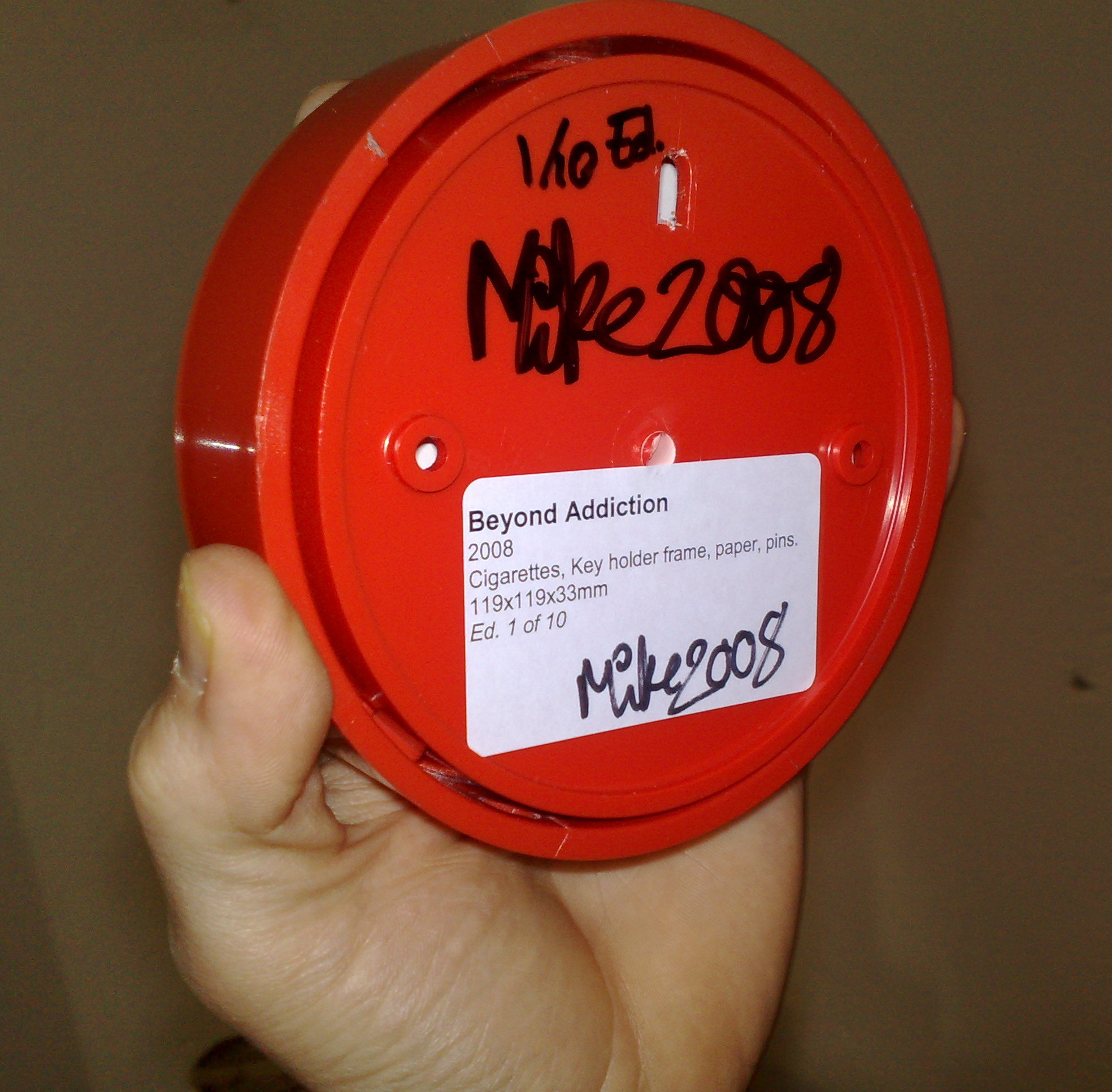
“Beyond Addiction” is a new, limited edition work by me. There are ten of them, handmade, each signed and numbered by the artist (that would also be me). The piece is made of cigarettes, pins, card, and emergency keyholder frames. The dimensions are: (h) 119mm x (w) 119mm x (d) 33mm, and come with fixing instructions and a couple of screws and wallplugs.

It’s been crazy precision work with a scalpel for the past few days, and I am cross-eyed, sore of hand, wrist and elbow, as I’ve basically made this work about 3 times more than what I needed to, just to get everything to be perfect. I spent a whole afternoon just trying to get the white card to be the right size to fit in the back of the tray. Another day spent cutting them (I threw about 15 away because they were too ragged). And so on.

Anyway, we’ll see if this works. This is my first attempt at selling artwork online, and I’m quite excited by the thought of people owning a piece of original artwork by me – so it’s a bit of an experiment to see how it goes.

PAX

Thursday, July 17th, 2008

After a long week starting with a rather horrific incident on Monday, I thought I would try my hand at doing a Free Art Friday effort.

Free Art Friday is simple idea – artists leave out a piece of their work on the street for anyone to take on Fridays – some lucky sod gets a nice piece of work to hang on their wall for nothing. Art for the masses. Its a great idea, on lots of levels.

I thought I would take some of the rubbish that gets left on our estate, and make it into artwork. It might stop the yoof throwing it at each other or hitting other people with it or throwing it at cars – something I see pretty much nightly outside my window. This particular piece of board was once all in one piece – part of a table I think – that someone left out about 3 months ago. The local council with their usual efficiency have yet to take it away, and it has been dismembered into about four pieces in that time.

This is fine for me, as it leaves me the raw materials for a triptych. PAX is almost a prayer on my part for peace, which is something we could really do with for the Summer here. In an area where even the wardens are dreading this coming weekend (the first weekend of the school summer holidays), I’m hoping that art can create calm. I’ll leave it outside in the derelict playground in front of my apartment, where the kids often come to drink and smoke, and sometimes kick each other.

Of course, PAX could still be used for hurling at people and cars, but I’m an artist, and this is probably the best I can do right now.

The Big Bang Circus

Wednesday, February 6th, 2008

I caught up with a friend of mine today, called Michael Teasdale.

Michael is a fellow artist who has been working away on a massive project for about ten years.

Well, it finally has a web presence. It’s called the Big Bang Circus. It’s still very much a work under construction, but I couldn’t resist telling you about it, as he deserves more recognition than he actually gets.

It’s an absolutely awesome work that threatens to take over his life (and more importantly yours) very soon. There are intentions to make a book/film/cartoon/universe/etc. The hook is that there’s a bit of a maze-like story to it, with hidden depths that you don’t find out about until you’re well and truly lost in it.

You can also see his other work at michaelteasdale.com (also under construction), which I’ve not seen before. Don’t be put off by the mugshot of Mike, though. He’s really very nice…

technorati tags:, , , , , , , ,

Finished Commission

Monday, November 12th, 2007


So the moot icon finally got its first outing last night.

I think it looks ok. It looks better in the dark…!

There’s still a bit of tidying up to do – some of the lines need dealing with, and the impact glue that I used to stick the chalice on with has has oozed out slightly, but otherwise, its fine.

I’m not averse to altering it further, actually. The initial reactions to it have been favourable, but I think it may need a little evolution as people get used to it, and respond to it.

We didn’t process it out into the mass like I’d hoped, but we will. For now, it’s just good that people get to see it and get used to it.

Here’s how I made it:

Intro, Pt.1, Pt.2, Pt.3, Pt.4, Pt.5, Pt.6

Tags: , , , , , , , ,