I’ve been having a lot of fun this week creating some art pieces using the social media platform Twitter.
Although people are quite keen to promote their art on Twitter, very few make their actual tweets into artworks (“Tweet” being a status update of 140 characters on Twitter) On the face of it, it sounds rather facile, but the works have become an exploration of ideas of creativity, authorship, existence, privacy and tangibility. And before too long, the process of the Art Tweets became REALLY complicated. Then it became even more complicated again.
So the first one went like this, as I blogged at the beginning of the week:

And you can look at the actual tweet on Twitter.
There’s nothing tangible about the work to pick up, or touch (or not touch it if you’re standing in an art gallery with security guards and “do not touch” signs everywhere). There’s no recorded piece of information as such. It’s only existence is what is known as a “Digital Footprint“.
However, it has intentionality, creativity, a creator (me) and we can talk about it in terms of it’s existence. What makes this a work of art? It’s akin to a Performance Art piece, but the closest thing I can think of is the drawings of Sol LeWitt, who created drawings straight on the wall without actually doing them – he wrote specific instructions and maybe a few sketches and then got his technicians to draw them for him, writing a certificate of authentication at the end.
The other thing is that it’s visual nature changes. The image you see above only looks that way because I’ve altered the background on my profile page of Twitter. Other people will see something entirely different, depending on how they’re viewing it. If I look at the tweet on my phone it will look different, not to mention all the different apps you can use to look at the tweet with, such as Tweetdeck, Plume, dabr, and so on. And yet it is visual in that you need to look at it and read it, and all of the different visual representations of the tweet contribute to it, and make it.
Adding further layers to the work, people can “Re-tweet” your tweet. So in other words, they can take what you’ve written and re-post it to everyone who is following them. It usually has an “RT” followed by your name at the start so people know where it has originally come from. And of course, people actually did this: @DaisyCarr, @jcalverttoulmin @omgitsridley all re-tweeted it very quickly.
So did that make them co-creators? Is it still a tweet and still the same work of art or is it a print or an edition? Traditionally a work of art is a work of art because the artist says it is (I chose the wording very deliberately).
So I explored the idea in the next two works.
#untitled2 looked like this:
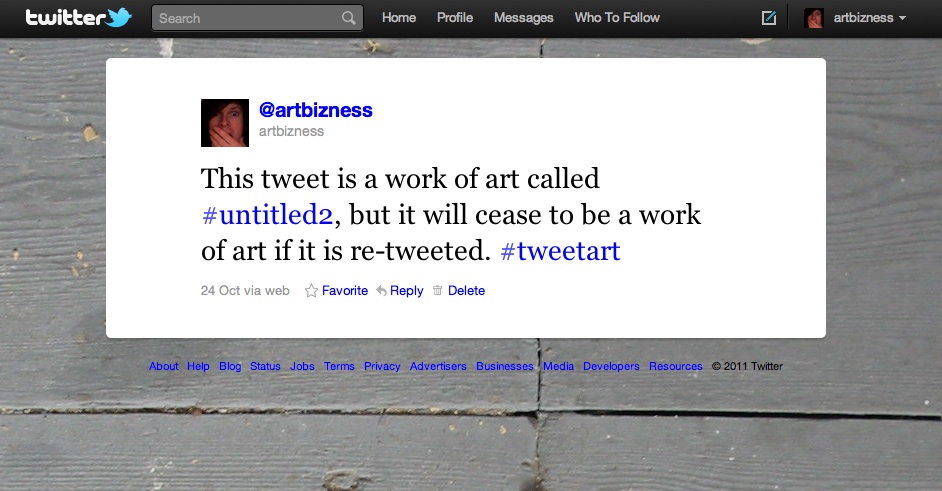
To some degree of surprise everyone respected this, and did not re-tweet the work. So at the time of writing, this work still exists, and it does so because I, as the artist, defined the parameters under which it exists. It also says something about the position of the artist in society. People are very compliant when it comes artistic endeavours. It also give the lie to the idea that Twitter is some sort of “digital wild west” and raises all sorts of questions about contemporary issues around so-called illegal downloading and perception management in terms of political lobby groups. Not to mention the demagogic potential of artistic deification and how that operates on social media platforms.
However, this piece only works because it subverts the platform. Twitter is social media. It only works because people interact and talk to each other. By denying people the opportunity to re-tweet, the work runs counter to the spirit of Twitter. However, in a kind of moebius loop, clearly people have interacted with in it. For people to respect the boundary created, they will have had to read the tweet and respect it, thus interacting with it. If a tweet is not responded to, is it still social media? Is the act of replying using the “@” symbol what makes social media social, or does the unknown response of the “lurker” also social, in that they reflect and/or act upon the tweet? Is the social a chain of unforeseen events, or is it more akin to a stalker’s silent phonecall? What is it about social media that makes it social?
So somewhat inevitably #untitled3 looked like this.
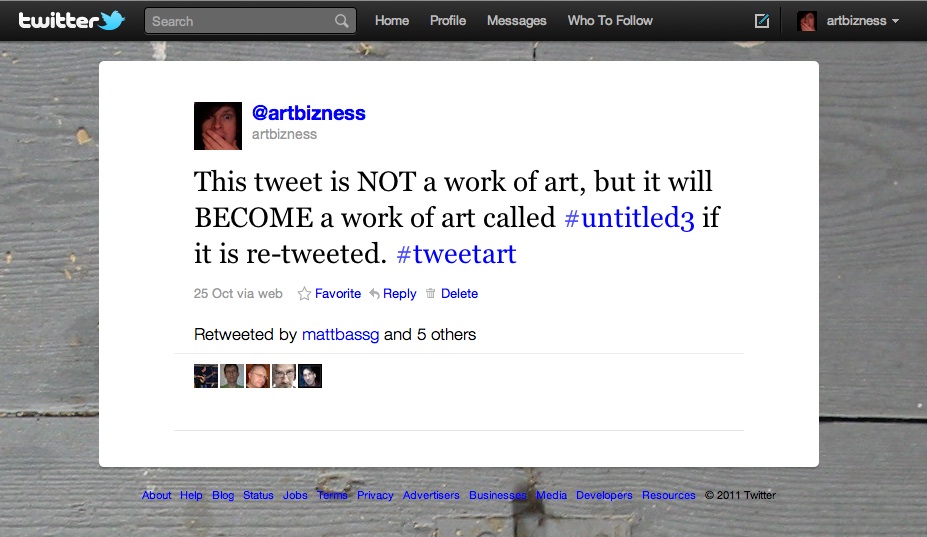
Once again the parameters of the work were defined at the start, and once again I could be said to be the author, but a condition was specified that the work only exists though the act of co-creation with other people. This embraces the idea of social media much more, and indeed many people obliged: @joanl, @mattbassg, @GeorgeV69, @solobasssteve, @tref, @IAmKat, @SteveBickle and @danielsladen so far at the time of writing. The work is still there, so feel free to continue become part of the work and co-create it.
However! A couple of weird things happened in this case. If you look at @IAmKat’s re-tweet, the wording has altered.
It’s quite common, when re-tweeting, to find that the ensuing tweet is then longer than 140 characters. It then requires editing to reduce it down to 140 characters – the wording changes but the gist of the tweet remains and the same idea remains. So Kat in fact tweeted “This tweet is NOW a work of art called #untitled3” So in making Kat a co-creator, did I also give her permission to alter the words, or has she created a new work? Is it within the right of me as the originator (without whom the work would not have existed) to stipulate what happens to the work, or does the artist leave the work to run like a clockwork toy, wound up and left to spin? To what extent to we alter any work when we look at it? When we go to see a Turner and create our own view of the work, regardless of (and sometimes contrary to) what the artist intended, do we alter the work? What about if we persuade other people that our interpretation is the correct one, and other people come to accept that that interpretation is correct?
Also – @danielsladen re-tweeted the tweet, but with an edition number at the start (Ed.1/9) I pointed out that I hadn’t specified that there were to be a limit on the number of re-tweets, or what would happen to any re-tweets beyond Ed. 9/9. However he explained that in fact he had used my tweet as a ready-made, and that in fact his work was a separate piece of work of which he is the creator. I like this idea a lot. It collects Marcel Duchamp into the fold of references around the work, and I’m pleased with the association as these untitled works definitely follow in the tradition of conceptualism that he in many ways fathered. Feel free to re-tweet @danielsladen’s tweet and with the next edition number – I don’t think (at the time of writing) that anyone else apart from me has collected the further editions he has left open for you to co-create with him.
#untitled4 was not a tweet but a hashtag, which is another feature often used in Twitter.
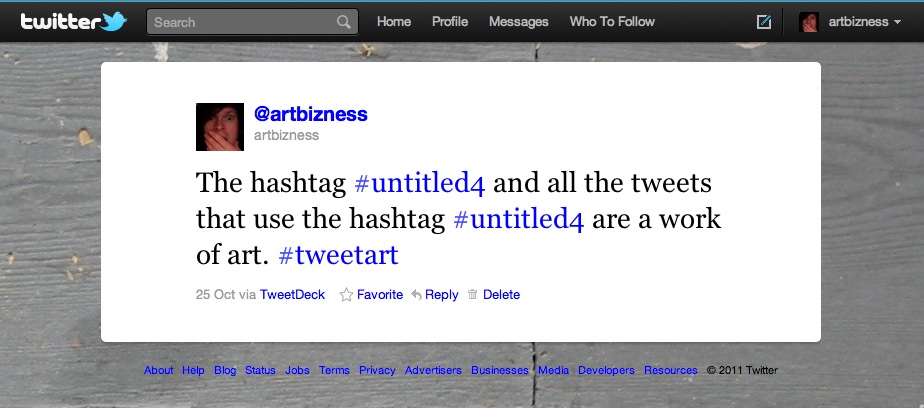
Explaining what a hashtag is and what it does is outside the scope of this blog post, but I remember a few years ago one guy started a hashtag and got quite annoyed about the fact that people were’t using it “properly” as he saw it, and wanted some sort of recognition of his place as the creator and guardian of it’s use. Cue hoots of derision from the twitter community. Once a hashtag is released in the wild it is in use becomes defined by users implicitly but very rarely explicitly. By defining parameters, I still have to relinquish control and yet essentially any tweets further down the line have been co-opted – not only those related to the work, but any future tweets that use the hashtag for other purposes (such as an event or a conference, etc.) also become part of the work, despite drastically changing the nature and function of that hashtag. Once again we call into question the nature of what constitutes a work of art and the extent to which viewers can alter the work. Also a new category of art consumer has been created – the art user. Art is often defined in terms of the fact that it has no function or “use” but by taking the term “user” (a computer term), and applying it to art, the parameters not just of art, but of consumption have changed.
I was also hoping that people would use #untitled4 to discuss the work in some depth. So far only @omgitsridley has stepped up to the plate, but there’s still plenty of time.
By the time you’re reading this, #untitled5 should no longer exist, except in reproduction form, as I will have deleted it.
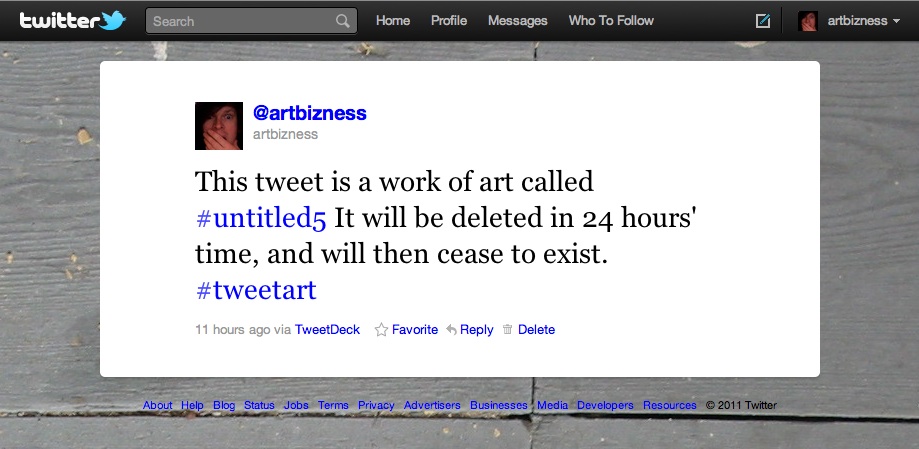
It is in the great tradition of temporary works of art. Personally I see it right alongside the work of someone like Andy Goldsworthy, for example.
However, can anything that is on the web truly be deleted? The work will still exist in some form or other beyond my control – perhaps in cached form. I was hoping that someone would re-tweet the work to preserve it. In the end I re-tweeted it myself because I wanted the work to join the long list of works that are “lost” but can only be seen in the form of a reproduction.
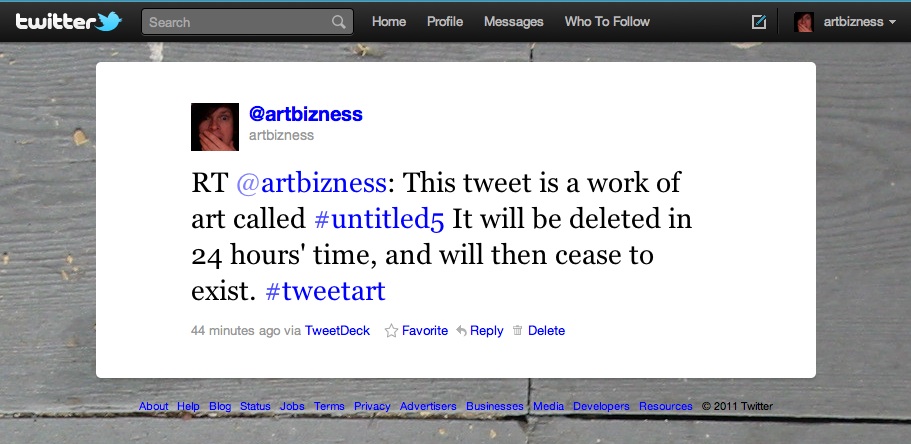
Again, the artist must relinquish control of the work and let it be stored in forms outside of control.
However, in a further twist, @Danacea “favourited” the piece. Twitter users often mark tweets as “favourite” either because they want to remember them and at a very basic level simply like them. However, they can also use it a way of marking tweets to remember them later. I haven’t yet asked @Danacea why she favourited that tweet, but my guess is that she wanted to see 1) if I would be true to my word, and 2) whether a tweet that has been favourited will disappear once deleted. A form of preserving a disintegrating work of art? Another attempt at reproduction?
And lastly #untitled6
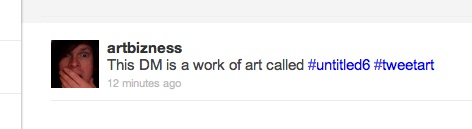
In Twitter, it’s possible to send Direct (or Private) Messages to other users. Known as “DM”s #untitled6 took the form of a DM mailed to the first people to respond to my previous works. All were sent, but it is not possible to DM people who aren’t following you, so @omgitsridley didn’t receive his.
I think the DM piece raises questions about privacy. Normally when DMs are sent in this way it constitutes spam, as the tweets are unsolicited. I deliberately sent the DM to people who had been previously involved in the works to give it a spammy feel. However, again the work succeeds in subverting internet mores, in that the recipients (certainly in the case of @datainadequate, @joanl, @ponor, and @IAmKat) were very happy to receive the work.
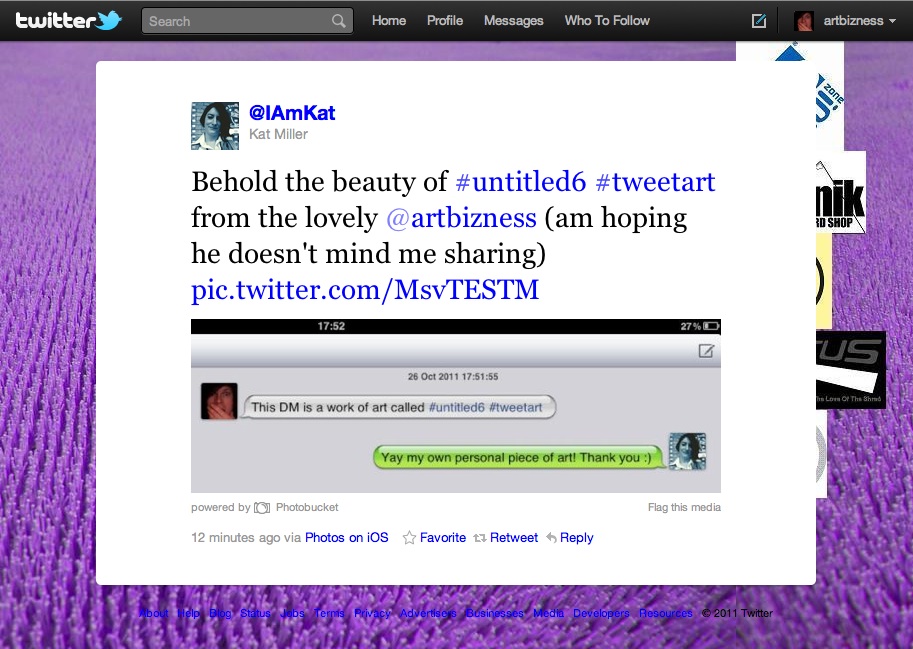
#untitled6 addresses elitism in art in a very visceral way. It deals with notions of exclusivity and closed networks in art, and exposes them for what they are.
This is the last of the #untitled series for now. There will be more in the future, but for now I feel that the six works so far stand to raise some serious questions about a whole load of things, and to provoke thought.
@datainadequate and @benjiw have taken the concept of #tweetart in a whole other direction which I also think is quite interesting. I’m looking forward to see how this might develop further. I hope to continue this debate within the work #untitled4.
Read More