When I was at art college, the idea of “skill” and “technique” was definitely a no-no. Ideas were everything. Concepts. Deep discussions with furrowed brows. That sort of thing. “Skill”, so the argument went, is something or someone that can be hired in to execute the idea for you. You don’t need to learn technique, and you should be more like a CEO, calling the shots and making the work happen. At push, you could actually paint with your own hand if you wanted to – but that was really just another stance; an idea about statement of intent. No one was interested in how amazing it was that someone could paint like that. The discussion straight away became about why you would want to do that in the 20th Century (yes it was that long ago that I went to art college).
Indeed, many major works are fabricated by Mike Smith, who I met on many occasions when I worked for a Fine Art storage firm back in the 90s.
When people used to ask me what sort of painting I did, it was never an easy question to answer. My favourite gag, and what I used to tell people, was that I did painting in inverted commas – I did “painting” rather than painting. To that end, I never really got down and sharpened up a technique. I’ve made a good fist of using a paint brush over the years, but I could have been a whole lot better at it if I’d made more of an effort to brush up on the skills required, if you’ll pardon the pun.
Part of the reason I’ve never really got the painting down as well as I might is that to some degree I agree with the above thesis. Ideas are important to work. I always wanted to be able to have ideas and concepts that I could do in any medium. I wanted the final works to be dictated by the idea, where ever it would take me. You can see, I hope, that if one had an idea that required a photographic representation of something, then one should probably just take a photo, rather than trying to paint like a photo (for example) purely because one is A Painter, otherwise it becomes about something different.
More than that, I didn’t want the skill of applying paint to a flat surface to be my schtick. Part of the allure, I think of art, any art, is that it takes you off into uncharted waters emotionally, intellectually, all sorts of ways – to the point where you should be able to forget about how it’s made. I would imagine that most people, when they’re listening to a piece of music, don’t spend the whole time listening out for the individual instruments or working out what notes are being played when. Rather, you let it wash over you as a cohesive whole.
However, as I’ve been involved in conversations with other artists online, I’ve noticed another perspective. Coming from a marketing point of view, it’s worth noting that using esoteric language is a classic example of “positioning”. It’s quite common to add value to something by talking it up. Put crudely, the more high-falutin it sounds, the more it’s considered serious and worthy of discussion. Clearly taken on this level, high-concept discussion add value to art works, and this could and does get used to increase the value to an artist’s work. The more sophisticated the better.
The flipside, of course, is that esoteric language is also a good way of keeping people out – anyone who doesn’t speak the lingo can quickly find themselves on the outside looking in, rather than the other way around. On the face of it, you might wonder why anyone would want to keep people away (surely you want to sell your work?) However, in fact the reverse happens – it makes people more curious. Like a group of people gathered round an accident, more people will come over to find out what it’s all about if they can’t quite make out what’s going on. Human nature.
A lot of the artists I’m meeting online seem to want to eschew the whole high-concept thing. Part of an Old Boys Club, they say. In a time when the internet is blowing open opportunities for artist to get their work out there and get on, its as if anything that indulges in deep concepts is “The Old System”, as if to say we need to be free of depth as well as the restraints of a closed system.
Personally I don’t buy it.
What I aspire to (and we can talk about how successful I am later) is that the same piece of work can be as complicated or as simple as you like. It should be possible to be able to look at work on a straightforward visceral level, but also to be able to go deeper should you want to – as deep as you like.
I’ve no doubt that using language to create a closed shop goes on, just as I have no doubt that that same language is sometimes used for “positioning”. However, I would argue that some people come to art FOR the depth, rather than in spite of it. It’s part of the allure, and there’s nothing wrong with it per se. Social media and art are both about connecting with an audience, and if that is your audience, then you’d be a fool to avoid it. Art should be more universal than that anyway.
Where does that leave me on the technique/conceptual continuum? I honestly don’t know. In fact I was hoping that I’d have a clearer idea by the time I’d finished writing this, but my suspicion is that it’s a false dualism/polemic/dialectic/dichotomy/how ever you want to put it.
Many artists such as Tracey Emin (check out the monoprints – much better than the tent or the unmade bed), Gary Hume, or Chris Ofili (who I recently reviewed here for his show at the TATE) have been very successful by developing a signature language – their own recognisable style that comes from skill and hard work (I recognise that all these people have technicians working for them, but the style is theirs, and was more than likely developed by their own hand to start with). Many of these artists also are able to talk about their works in quite a sophisticated way, too. All of them have been able to cross the boundaries between High Art, and the Common People (and no, that is not MY dualism).
I had a good day in the studio yesterday. It took a while for me to get the confidence back, with me spending about 2 hours in a state of extreme agitation, staring at a half-started work before even being able to pick up a brush.
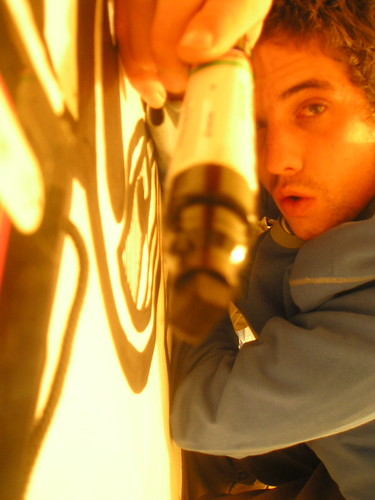
This is based on a photo I took of myself. The image was then taken into Photoshop, and broken down into simpler colours. I then painted the simplified version of that photo. Once it was dry, I re-did the picture in Photoshop again, this time with slightly more complicated colours, and then repainted the whole thing over the top. This means that there was lots of nice underpainting that gives the work a healthy complexity and a “glow” from below.
I then repeated this process again a few times, building the painting up layer by layer. This is not the last layer, but it is the penultimate layer. The whole thing is done with acrylics, and the paint is quite thin – I like the flatness of the surface, rather than the built up thickness that you get with oils.
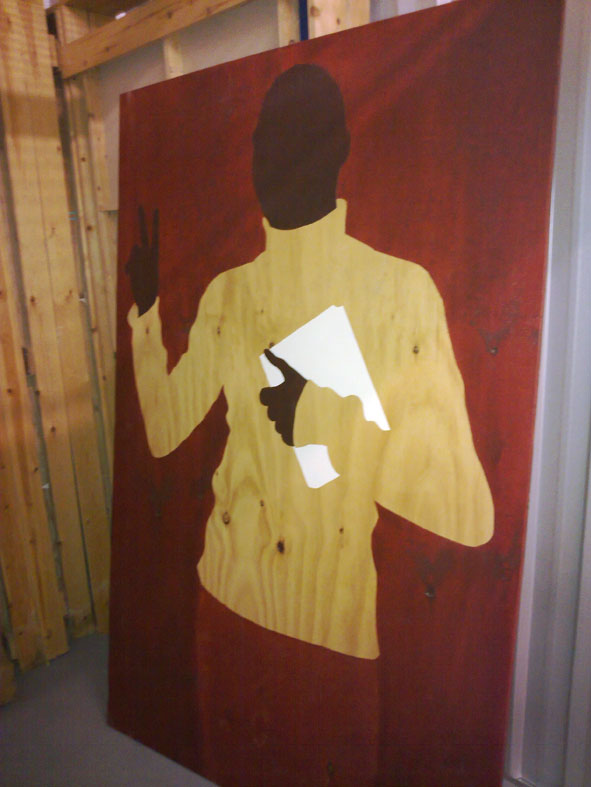
It’s painted on a piece of board that I found. I really think that in order for a work to exist in the world, it needs to justify its existence from an ecological point of view. There are already too many objects in the world – too much junk. So from now on, I’m going to start painting on and with stuff that I’ve found. There’s enough of it lying around where I live – people dump all sorts of rubbish (wardrobes, cupboards, etc.) with lots of flat surfaces to paint on. While this painting that I’m doing looks rather traditional, it won’t be when I’ve finished with it. I’ve barely started in fact.
Now I just need to order those red LED fairy lights for it…
The show marks a departure for Hirst, as he attempts to paint using oil paints by his own hand, rather than the style that has made him famous – usually executed by a trained army of technicians. As such I had high hopes for this show, as I was interested to see where Damien, a sculptor in the broadest sense, could take my discipline (“painting”).
Sadly I have to say I was distinctly unimpressed. I don’t say “unimpressed” in the throwaway sense, I mean that i was waiting for something about his paintings to impress something upon me. Nothing did.
I was not impressed by his draughtsmanship. There was nothing about the trees in particular that suggested any degree of mastery, the lemons looked flat and impact-less, and the best-rendered objects (the skulls) had no impact on me at all.
I was not impressed by any conceptual thinking. There is clearly some attempt at memento mori going on here, and the recurring motifs of his previous work suggest a man reflecting on the vanity of his career. But that’s about it. Not enough to sustain a body of work, not even for a whole show. There’s more than a nod to the work of Francis Bacon here, but to what end?
I’m not impressed by his technical ability. Some of the priming underneath the paint on one or two of the canvases has clearly cracked and curled in away that strikes me as too inept to be intentional.
I wasn’t scared by them, I wasn’t intimidated by them, I wasn’t amused by them… nothing.
My feeling is that they’re not good enough to show yet. Given Hirst another 5-10 years of painting, and then they might be good, but for me the only work worth looking at was the one labeled No. 2 Title: “Small Skull With Lemon and Ashtray.” You could quite conceivably walk in, look at that painting and walk straight out again. It would tell you all you need to know about this show, without you having to be disappointed by the rest of it.
Many years ago, the artist Gary Hume had a pop at Hirst’s inability to understand a few home truths about his work. With a wink and a smile, he said something along the lines of “Well, he’s not a painter, so he wouldn’t understand!” On the strength of this show, I’d have to say that Hume is right.
I have to confess to being a bit of a fan of Hirst’s work, and I really wanted to like this show, but I didn’t. I’m happy, though, for him to continue working like this in anticipation that he’s going to get better at it. Here’s hoping.
Sometimes I wonder what you see when you look at my work. Do you see years worth of experience accumulated in the work? Do you see master craftsmanship? Do you have an un-nameable emotional reaction when you see my work?
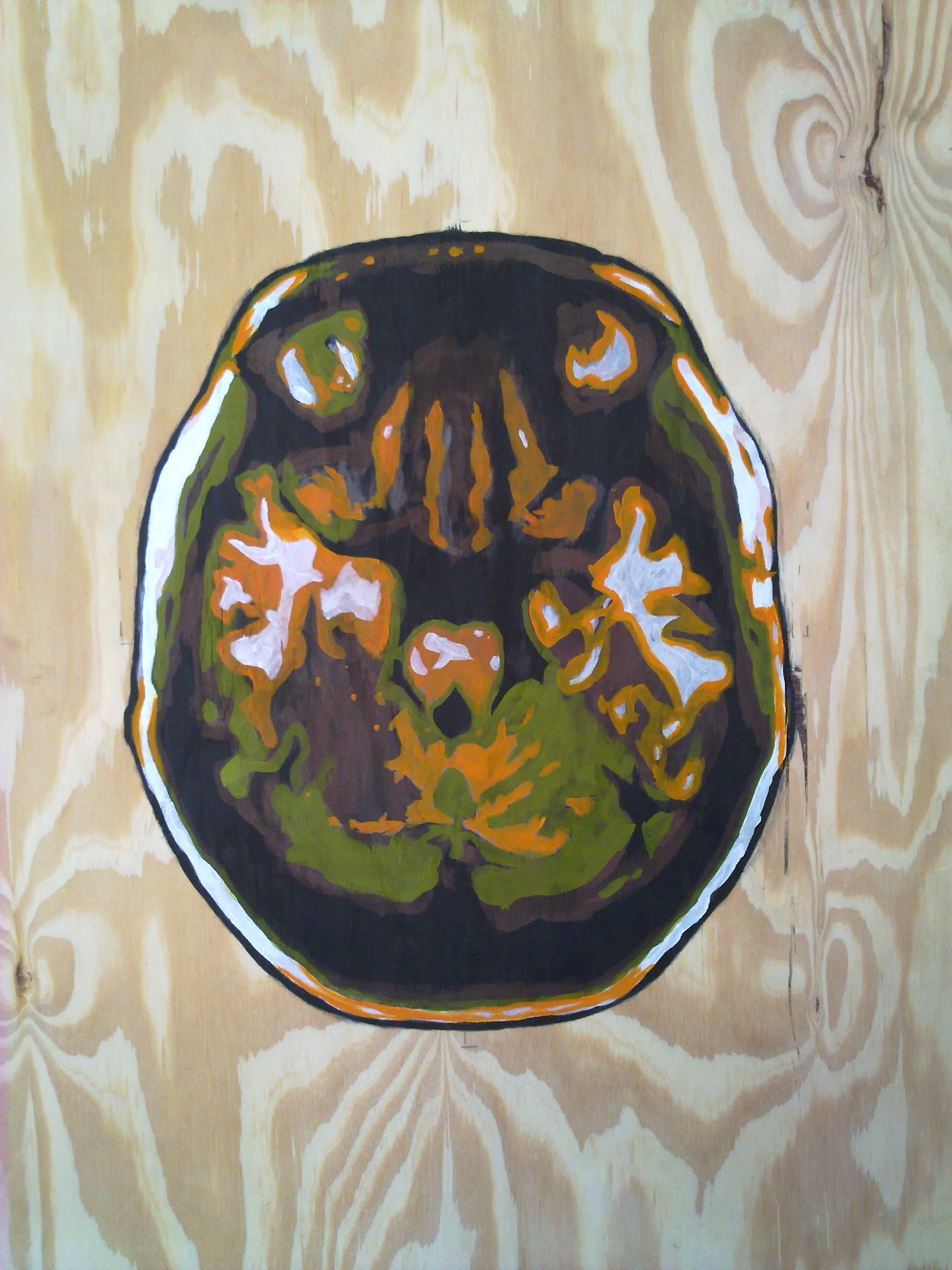
This piece of wood has been kicking around my apartment for months now, and the other night I started painting on it. It’s the sort of piece of wood that you might throw away when you’ve finished working on your house. A nice offcut. Flat and smooth, with some nice grain patterns on it.
I have no idea where this work is going – it’s more like a practise piece. I’ve taken a photo of myself (and no, I have no messiah complex, but I do seem to be crucified every time I do anything) then pulled it into Photoshop. If you use the “posterise” feature, it reduces the number of colours in the photo.
So I thought that if I reduced the number of colours to 4, and painted that, then reduced the number of colours to 8, and painted that over the first one, then eventually I could build it up over time, so that it looks dense and translucent when you look at it.
This is all done pretty freehand though, with a vague attempt at gridding it up, and sketching it out in pencil first.
If you yourself ever put brush to wood/canvas/board, you’ll know that making a work is a voyage of discovery. When drawing your arms, you just couldn’t believe you are that muscley, as in your head, you’re always the skinny kid from school. You realise you can’t draw hands. You notice that the paint soaks into the wood if you haven’t primed it in some way, but you then think that it might be fine because it gives it a ghostly feel. And so on.
But I think that you the viewer wants to know that for every painting that you see from me, there are probably hundreds like this one, that may never see the light of day – that are the duds, the throwaways. That the ones you do finally get to see are the best of the best.
Greetings if you are joining me for the first time. I have now officially moved my website here from my old blog.
It’s been quite an effort of will to build this site, involving many hours of squinting at code that I barely understand, but here we are.
I feel like there should be more of a fanfare or something, but if you have stuck with me thus far, then thank you so much, and I look forward to you sharing the rest of the journey with me here. Just remember to change your feed readers so they point here, instead of the old place.
If you have no idea what a “feed reader” is, then a) don’t worry and b) google it.
Anyways, here’s another short video of the Urban Art Fair I was at two weekends ago. it gives a good flavour and feel of the event.
This is a piece of work I finished recently. It’s called “O Sacred Head.”
I have put the work directly onto a scanner, and scanned it in order to offer it as a free piece of artwork for all my blog readers.
No trick – just right click and save, or click and hold if you’re a mac user.
I reckon it would make a good dekstop image, but you can do anything you like with it – print it out, put it on a business card, anything you like, just as long as you’re not making money directly from it.
Of course, if you want to buy the original in all it’s tangible glory, you’ll have to come along and to the Urban Art Fair tomorrow or Sunday, where I’ll be showing it (along with my other paintings), hung from the railings in the street.
Well, it’s finally almost here. The Urban Art Fair is upon us on Saturday and Sunday this week. I’ve made all the work I have time to make, and it’s now out of my hands – just packing everything up ready now. Below are some examples of the work I’ve made, which will all be in the show.
I’m looking forward to it, and also praying for a sunny day. I’m especially looking forward to meeting my lovely blog readers. See you then.
It’s made again with Japanese endpapers, and with acrylic paint, spray paint, felt marker, varnish and dirt.
The figure is based on some random photos I took from the window of the bus, as I passed through Brixton on my way home. There was something about the way he was looking that seemed to work really well with defacing of the paper. The defacement could be graffiti, but it also fits with the whimsical marks of abstract expressionism (with a nod to Cy Twombly’s mark-making).
If there is a recurring theme in this series of paintings, it’s the contrasts along with the surprise of the incongruity of things.
It’s amazing what a good morning in the studio can do for your confidence as an artist. The results in the photo above speak for themselves, I think. Click on the image, and you’ll get a much better look at the work.
I’m not sure what to call this yet, but it’ll be something like “Awe” or “Shock & Awe”. Or maybe even “AW!”
Dimensions wise, it’s (h)50 cm x (w) 35 cm x (d) 5 cm, or 19 1/2″ x 13 1/4″ x 2″ in British.
I’m really really pleased with the way this has turned out. A few months ago, you may remember, I bought some Japanese end paper (the sort that goes in the inside cover of hardback books) with the idea of doing something with it.
I’ve spent ages making a frame, and glueing the paper to it nice and flat using wheat starch paste. Wheat starch paste is what the pros use to put in Japanese end papers. It’ll basically last for ages, and is about the best quality stuff there is. PVAs and other cheaper glues tend to dry out in no time, which means they go yellow, and stop being sticky. You don’t want your painting falling off, now do you?
Anyway, it seemed fairly obvious to paint something contrasting on the top, and I like the humourous play of the guy being awed by the flock of cranes (I think they’re cranes. Maybe they’re swans) in the background. This is also quite unusual for me, in that I don’t usually paint figuratively (awful word, but you know what I mean). I’ve hand painted the figure in acrylic, and paid a lot of attention to detail. I didn’t project it and trace at all it this time. I cut out one of my own photos, and used it as a stencil for the outline, but the rest was completely freehand.
I think this is the start of a very good series of works. More to come.
By the way, don’t forget that I’m moving this blog shortly. RSS readers and bookmarks at the ready now. I’ll tell you when and where soon. Not long now…